
Quick summary
| Question | Short answer |
|---|---|
| Price from | Streets and piazzas free; paid interiors (Castel Nuovo, Santa Chiara cloister, Sansevero Chapel) roughly €5–15 each — check official sites |
| Hours | Streets always open; churches mostly mornings and late afternoons; castles and museums daytime with a weekly closing day |
| Book ahead? | Only for the Sansevero Chapel (sells out days ahead) and popular guided walks in high season |
| Time needed | Half a day for the walk; a full day with interiors |
| Start point | Piazza del Plebiscito or Piazza Municipio — both on metro Line 1 |
The Naples old town is really two old towns. Down by the sea sits the monumental quarter — Piazza del Plebiscito, the Royal Palace, Castel Nuovo, Galleria Umberto I — built by kings and meant to impress. Uphill lies the centro storico proper — Spaccanapoli, Via dei Tribunali, San Gregorio Armeno — built on the Greek grid of Neapolis and meant to be lived in. The classic walk links the two, sea to grid, in about three kilometers; this guide follows that direction.
The monumental quarter: Plebiscito to Castel Nuovo
Piazza del Plebiscito & the Royal Palace
Piazza del Plebiscito is the biggest open space in central Naples — a sweeping colonnade facing the church of San Francesco di Paola on one side and the Royal Palace on the other. It's at its best early morning (empty, echoing) or at night (floodlit). The palace's royal apartments are a worthwhile paid visit covered in our Naples museums guide; the piazza itself costs nothing and hosts concerts and events through the year.
Galleria Umberto I
A minute away, the Galleria Umberto I is a 19th-century shopping arcade with a glass-and-iron dome nearly 60 meters high — Naples' answer to Milan's Galleria, built in the 1880s during the city's great urban renewal. Walk in for the floor mosaics and the dome; it's free, open to the street, and glorious in late-morning light when the sun drops through the glass.
Piazza Municipio & Castel Nuovo
Piazza Municipio runs from the city hall down to the port, dominated by Castel Nuovo — the Maschio Angioino — with its improbable white triumphal arch squeezed between dark Angevin towers. Inside are the Palatine Chapel, the Hall of the Barons and a civic museum; the metro station below the piazza doubles as an archaeological display, with Roman ship finds unearthed during excavation. The square is also the gateway to the port: cruise passengers from Stazione Marittima surface here first, and tours starting around Piazza Municipio make it the natural meeting point. From here, Via Toledo climbs toward the grid — with the Spanish Quarter hanging off its western side.
The centro storico: Spaccanapoli and the Greek grid
Spaccanapoli, the Naples splitter
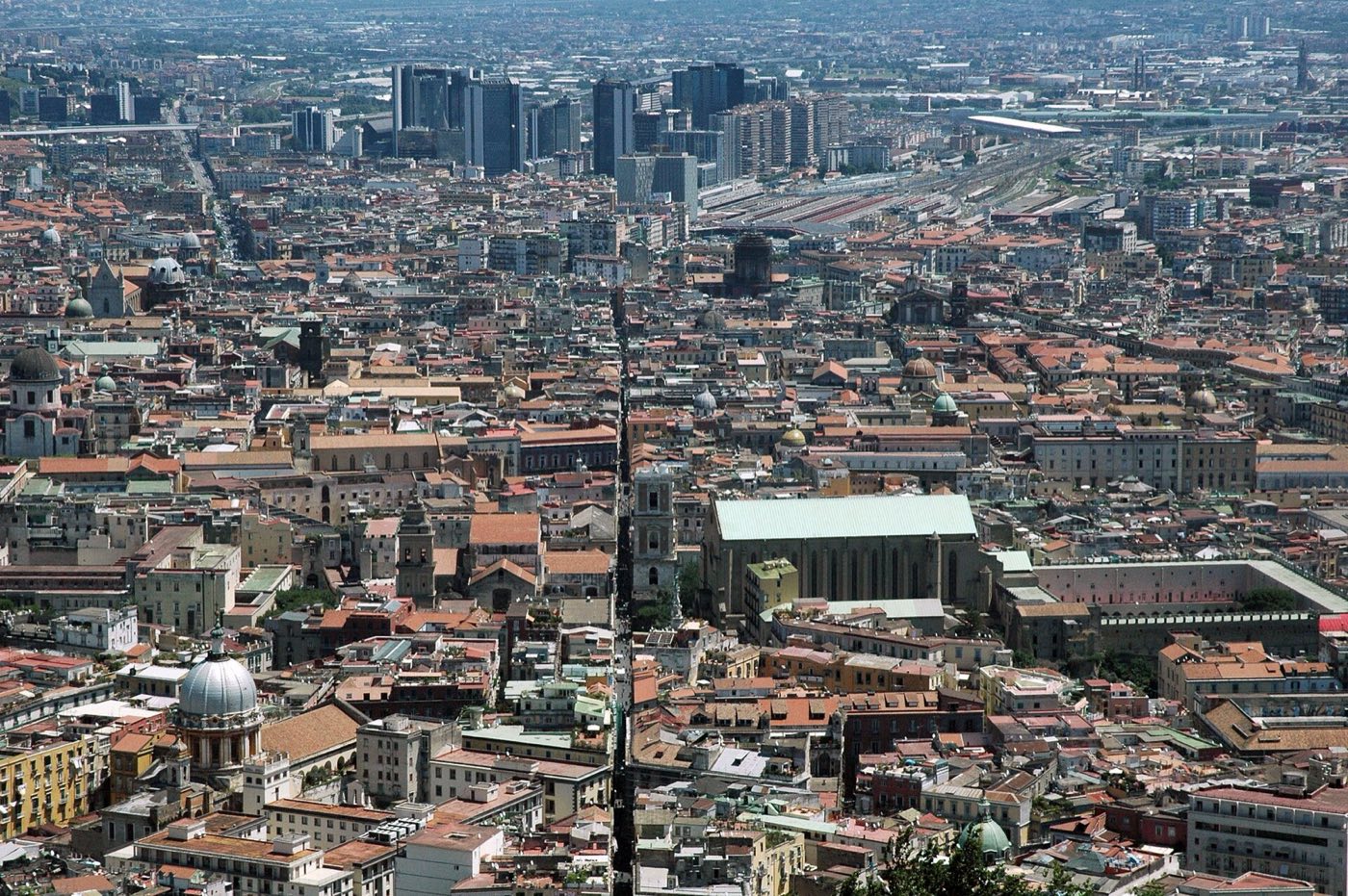
Spaccanapoli is the straight street that visibly slices the old town in half — you can see the cut from the Vomero belvederes in our viewpoints guide. It follows the lower decumanus of Greek-Roman Neapolis and changes names as it goes: Via Benedetto Croce past the monastery of Santa Chiara (whose majolica-tiled cloister is one of the city's loveliest paid interiors), then Via San Biagio dei Librai past palazzo courtyards, shrine niches and silversmiths. Give it two unhurried hours: the street is the attraction.
Piazza Bellini & Via dei Tribunali
Piazza Bellini is where the old town relaxes: café tables around a sunken excavation of the ancient Greek walls of Neapolis, visible four meters below street level. By day it's the civilized coffee stop; after dark it becomes the historic center's living room — more on that in the nightlife guide. One block over, Via dei Tribunali — the major decumanus — runs the gauntlet of famous pizzerias, the Duomo of San Gennaro and the entrances to the city's buried level; the parallel world of cisterns and war shelters below it is covered in our Naples underground guide. You can browse what runs around Piazza Bellini — evening walks included.
San Gregorio Armeno & the craft workshops
Connecting the two decumani, Via San Gregorio Armeno is the nativity-scene street: workshops making presepi and terracotta figurines year-round, from traditional shepherds to this season's footballers and politicians. It's genuine craft, not just souvenir theater — many workshops let you watch the modeling and painting. In November–December the street becomes a slow-moving river of people; go on a weekday morning. If watching makes you want to make something, hands-on ceramics workshops in Campania are bookable by the hour — painting your own tile or figurine beats buying one.
Self-guided vs guided: how to do the old town
| Option | What you get | Best for |
|---|---|---|
| Self-guided walk | Free. The route in this guide: Plebiscito → Galleria → Municipio → Via Toledo → Spaccanapoli → San Gregorio Armeno → Tribunali. Pay only for the interiors you choose. | Repeat visitors and budget travelers who read up first. |
| Guided walking tour (2–3 h) | A guide decodes the layers you'd walk straight past — Greek walls, guild streets, wartime stories, superstitions. Small groups typically €25–40 per person, as listed on GetYourGuide. | First-timers. The old town is the most context-dependent sight in Naples. |
| Walk + underground or chapel combo | Combines the street walk with Napoli Sotterranea or the Sansevero Chapel — one booking, one timeline, the two levels of the city in an afternoon. | Anyone on a tight schedule; see the Veiled Christ guide for why the chapel needs pre-booking. |
| Food-first version | The same streets eaten rather than narrated: pizza a portafoglio, cuoppo, sfogliatella, coffee rituals. | Second-day visitors — compare formats in the food tours guide. |
Timing is everything
- Start before 9:30am. The centro storico is at its photogenic best — shutters opening, deliveries by scooter — and Santa Chiara and the churches are quiet until mid-morning.
- Churches close midday. Most open roughly 8:30–12:30 and again late afternoon; plan interiors around the siesta gap.
- Saturday afternoons and Sundays are the crush on Spaccanapoli and San Gregorio Armeno — Neapolitans promenade too. Tuesday–Thursday are calmest.
- December is its own season: the nativity street is unforgettable and unmoving. Go at opening time or accept the shuffle.
- Best light: late morning for the Galleria dome; golden hour on Piazza del Plebiscito's colonnade; blue hour for floodlit Castel Nuovo.
How to save
- The best of the old town is free: every piazza, the Galleria, Spaccanapoli, San Gregorio Armeno and most church naves cost nothing.
- Pick two paid interiors, not five. Santa Chiara's cloister plus one of Castel Nuovo or the Sansevero Chapel covers the spread; ticket fatigue is real.
- First Sunday of the month: state museums nearby (including the Royal Palace) usually waive entry under the Ministry of Culture scheme — confirm before planning around it.
- Artecard math: doing three or more paid sites in three days? The Campania Artecard likely pays for itself — run the numbers in our city pass guide.
- Book the chapel early, not dearly: Sansevero tickets at face value disappear days ahead; last-minute resellers charge more for the same slot.
How to get there
Metro Line 1 is the old town's spine: Municipio station for Castel Nuovo and the port end, Toledo (the famous mosaic-vaulted station) for Via Toledo and the Spanish Quarter edge, Dante and Università for the Spaccanapoli grid. From Napoli Centrale, ride Line 1 from Garibaldi four stops to Dante rather than walking the charmless stretch of Corso Umberto. The monumental quarter is flat; the grid is gently uphill with broken paving — wear real shoes. Full network details, funiculars included, are in the getting around Naples guide.
FAQ: Naples old town
What is Spaccanapoli?
Spaccanapoli — literally "Naples splitter" — is the arrow-straight street that cuts the historic center in two, following the ancient Greek-Roman grid. It changes name several times along the way (Via Benedetto Croce, Via San Biagio dei Librai and others), and walking its length is the single best introduction to the old town.
Is the Naples old town free to visit?
The streets, piazzas and Galleria Umberto I are free, and so are most churches. You pay for specific sites: Castel Nuovo, the Santa Chiara cloister, the Sansevero Chapel and the underground tours all have entry fees, typically in the €5–15 range each (check official sites for current prices).
How long do you need for the old town of Naples?
A focused walk from Piazza del Plebiscito through Spaccanapoli takes about half a day. Add paid interiors — Castel Nuovo, Santa Chiara, the Sansevero Chapel or an underground tour — and it fills a full day comfortably.
Is a guided walking tour of the old town worth it?
If it is your first visit, yes. The old town's layers — Greek walls, Roman streets, baroque chapels, wartime stories — are invisible without context, and a 2–3 hour guided walk covers what would take days to piece together on your own. Confident self-guiders can do fine with a good route and this guide.
What is San Gregorio Armeno famous for?
Nativity scenes. The narrow street is lined with workshops making presepi (crib scenes) and their figurines all year round — from traditional shepherds to figurines of current footballers and politicians. It is at its busiest and most atmospheric in November and December.
Is the old town of Naples safe?
By day, yes — it is busy, policed and heavily walked by visitors. Use standard big-city habits: keep phones and cameras off the street side, mind your bag in crowds, and be alert for scooters in the alleys. At night stick to the lively spines like Piazza Bellini and Via dei Tribunali.
Can you visit Castel Nuovo inside?
Yes. Castel Nuovo (the Maschio Angioino) houses a civic museum, the Palatine Chapel and the Hall of the Barons, and you can climb sections of the walls. Expect a modest entry fee and daytime hours with a weekly closing day — verify on the official site before you go.
The Naples old town doesn't need a checklist so much as a direction: start grand at Piazza del Plebiscito, let Via Toledo pull you uphill, and give Spaccanapoli the slow hours it deserves. Pay for two interiors, skip the rest without guilt, and book a guided walk if this is your first time — the streets are free, but the stories underneath them are the point.