
Quick summary
| Question | Short answer |
|---|---|
| Price from | The quarter itself is free; guided walking tours roughly €25–40 per person as listed on GetYourGuide |
| Hours | Always open — it's a living neighborhood. Best between late morning and early evening |
| Book ahead? | Tours: a day or two ahead in high season. The streets: never |
| Time needed | 2–3 hours for the walk and the Maradona shrine; add lunch and it's a half day |
| Getting in | Metro Line 1 to Toledo; the quarter starts one street uphill |
The Spanish Quarter — Quartieri Spagnoli — is a tight grid of alleys climbing west from Via Toledo, laid out in the 1500s to billet the Spanish garrison and never gentrified into a museum. Roughly fourteen thousand people live in less than a square kilometer here, many in bassi — one-room, ground-floor homes whose front doors open straight onto the alley. For decades guidebooks told visitors to stay out. That advice is out of date: today the lower quarter is one of the city's main draws, for the street art, the Maradona shrine and some of the best cheap food in Naples. What it hasn't become is a theme park — which is exactly why it's worth your time, and why a bit of orientation helps.
Street art and the Maradona shrine
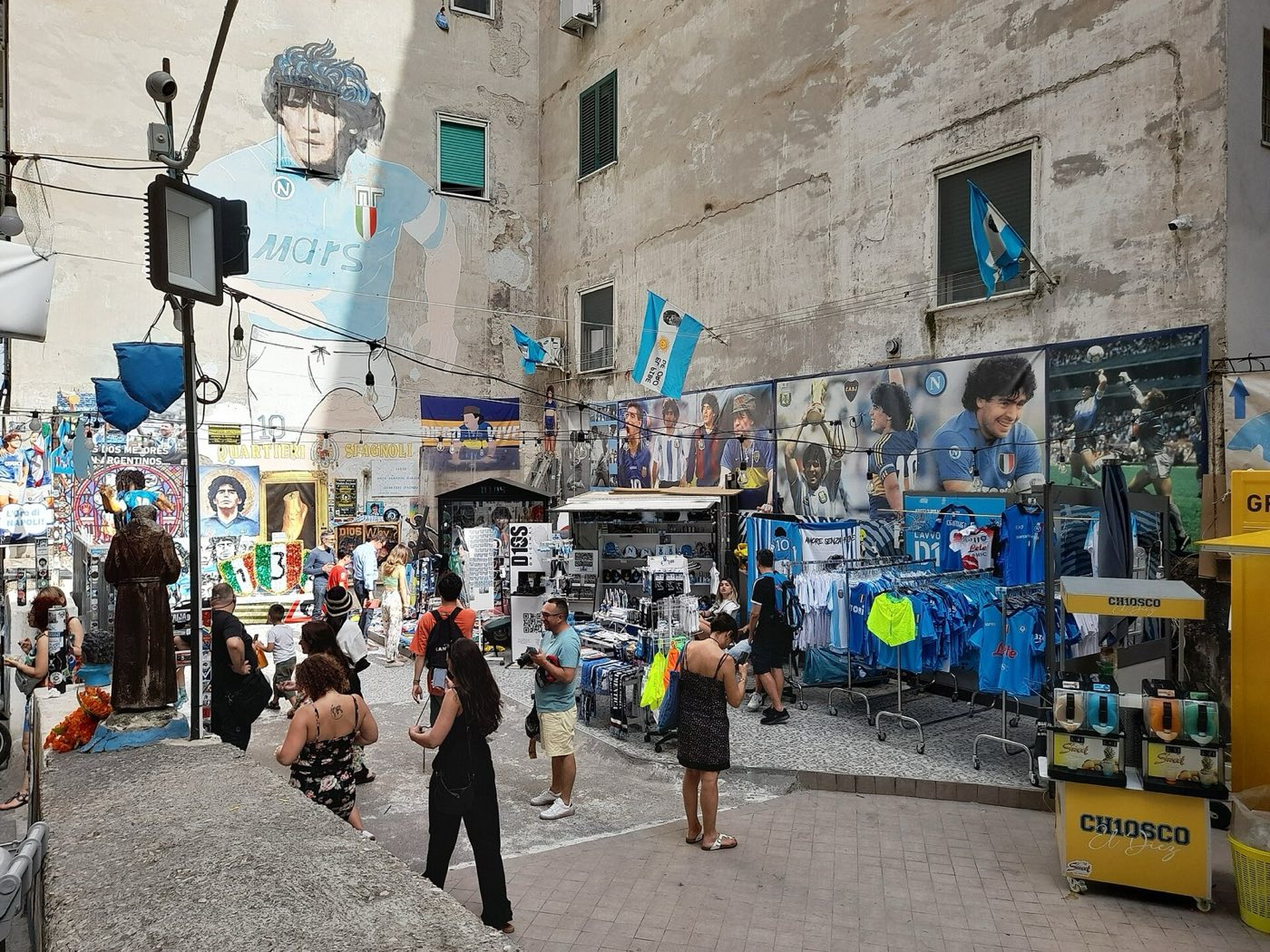
The quarter's walls carry everything from stencil work to multi-story murals, much of it clustered on the climb toward its most famous address: Largo Maradona. The giant mural of Diego Maradona here was first painted in 1990, after Napoli's second scudetto, and restored after his death in 2020; the courtyard around it has grown into a genuine open-air shrine — scarves, photos, votive cabinets, blue-and-white everything. Entry is free, the crowd is constant, and the atmosphere lands somewhere between stadium and chapel. Football pilgrims should pair it with the stadium tour and the rest of the trail in our dedicated Maradona in Naples guide.
Beyond the shrine, keep climbing: the upper lanes hold quieter murals of local saints and singers — San Gennaro and Totò among them — and the higher you go, the fewer cameras you'll see. The art changes year to year; that's part of the point.
What (and where) to eat
The Spanish Quarter feeds Naples cheaply and well. The formula: family trattorias where the menu is recited rather than printed — look for pasta alla Genovese (the slow onion-and-beef ragù the city adores), Sunday-style ragù, and seafood antipasti — plus street-food counters selling pizza a portafoglio (folded into paper, eaten walking) and the cuoppo, a paper cone of fried fish and vegetables. Prices in the quarter generally undercut the old town's tourist rows, but fame has arrived: the best-known trattorias queue from 12:30. Eat before noon or after 14:00, or book where booking is possible. For a guided eating route through here and beyond, compare the Naples food tours and cooking classes.
Is the Spanish Quarter safe? The honest version
The question every visitor asks, so here's a straight answer. By day, the visited parts of the quarter are safe — the lower lanes off Via Toledo and the route to Largo Maradona are full of tourists, shopkeepers and café tables, and the realistic risks are the same as anywhere crowded in Naples: pickpockets working the crush, and scooters sharing alleys with pedestrians. Phone snatches from the curb side happen; keep it holstered near the street edge and don't leave bags dangling off chairs.
After dark, be selective rather than scared. The lower quarter's food streets buzz well into the evening and are fine; the upper grid empties out and is not where you want to be wandering with a camera at midnight. The quarter's rough reputation is decades old and mostly outdated, but it isn't pure myth either — this is a dense working neighborhood, not a stage set. Walk with purpose, dress down the jewelry, and you'll almost certainly experience nothing worse than a scooter passing closer than you'd like. Solo travelers who'd rather not think about routes at all: that's the single best argument for a guided walk.
Self-guided or walking tour: what a guide actually adds
| Option | What you get | Best for |
|---|---|---|
| Self-guided wander | Free. Enter from Via Toledo, climb to Largo Maradona, eat, drift back down. You'll see the surfaces and miss the stories. | Repeat visitors, confident city walkers, tight budgets. |
| Guided walking tour (2–3 h) | A local navigates the grid, unpacks the garrison history, basso culture and the Maradona cult, and usually adds a tasting stop. This walking tour is the benchmark format. | First-timers and anyone visiting alone — context plus company. |
| Street-art & Maradona focus | Sightseeing routes built around the murals and the shrine, some ending at the stadium. Browse Spanish Quarter sightseeing tours. | Football pilgrims and photographers. |
| Combined quarter + underground | Pairs the alleys above with the cisterns and war shelters below — the quarter has its own underground tour entrance. | Half-day planners who want both layers in one go. |
Timing is everything
- Late morning is the quarter at its most itself: markets out, laundry going up, bassi doors open. Good light hasn't left the lower lanes yet.
- Eat at noon or at 14:00 — the famous trattorias queue heavily in between.
- Late afternoon gives the best light at Largo Maradona and rolls straight into aperitivo in the lower lanes.
- Sundays feel different: quieter shops, fuller lunches. Match days — see the Maradona guide — turn the whole quarter blue and loud; brilliant if you're in the mood, chaotic if not.
- Photographers: the alleys run east–west off Via Toledo, so early and late sun shoots straight up them; midday drops the whole grid into shade.
How to save
- The headline sights are free: the murals, Largo Maradona and the neighborhood itself cost nothing.
- Lunch here, not on the seafront: a full trattoria meal in the quarter often costs what a single dish does on the tourist rows.
- Tour + tasting beats tour, then lunch: many walks include tastings that add up to a light meal — check what's listed before doubling up.
- Group rates and kids' prices exist on most walking tours; exact brackets vary by listing, so read the GetYourGuide fine print.
- No tickets needed means no pass needed: save the Artecard budget for the museums — the math is in the city pass guide.
How to get there
Metro Line 1 to Toledo — itself worth seeing for the mosaic-vaulted "Crater de Luz" — puts you at the quarter's front door: cross Via Toledo and any westward alley takes you in. The Funicolare Centrale at Augusteo, a few steps south, brushes the quarter's edge on its way up to the Vomero, and Piazza del Plebiscito is a 5–10 minute walk from the southern lanes. The grid climbs steeply westward — enter low, climb to the shrine, and descend a different alley than you came up. From the top, you're minutes from the funicular up to the Vomero viewpoints; back on Via Toledo, the old town walk continues north. Full transit details live in the getting around Naples guide.
FAQ: Spanish Quarter Naples
Is the Spanish Quarter in Naples safe to visit?
By day, yes — the lower streets near Via Toledo and the route to the Maradona mural are busy with visitors, cafés and shops, and the main risks are pickpocketing in crowds and scooters in narrow alleys. After dark, stick to the lively lower lanes and trattoria streets rather than wandering the quiet upper grid. Standard city sense applies: no flashed valuables, phone away from the curb side.
Where is the Maradona mural and does it cost anything?
The giant Maradona mural and the surrounding shrine fill a small courtyard-square known as Largo Maradona, in the heart of the quarter — roughly ten minutes uphill from Via Toledo, and it is free. The original mural dates from 1990, was restored after Maradona's death in 2020, and the area around it has grown into an open-air shrine of scarves, photos and votive cabinets.
Is a Spanish Quarter walking tour worth it?
For most first-timers, yes. A local guide navigates the grid, explains what you are looking at — Spanish garrison history, basso doorway culture, the Maradona cult — and gets you talking to people rather than photographing them. Tours typically run 2–3 hours for roughly €25–40 per person, as listed on GetYourGuide.
What is the Spanish Quarter famous for?
Built in the 1500s as housing for Spanish garrison troops, the quarter is now famous for being Naples at maximum density: laundry-strung alleys, ground-floor basso homes opening onto the street, some of the city's best cheap trattorias, a wave of street art, and the Maradona shrine at Largo Maradona.
What should I eat in the Spanish Quarter?
Classic Neapolitan trattoria food and street food: pasta alla Genovese, ragù, pizza a portafoglio folded into paper, cuoppo of fried seafood, and pastiera or babà for dessert. The quarter's family-run spots tend to be cheaper than the old town's tourist rows; queues form at the famous names by 12:30, so eat early or late.
How do I get to the Spanish Quarter?
Take metro Line 1 to Toledo station — the quarter starts directly uphill from Via Toledo — or the Funicolare Centrale from Augusteo, a few steps away. From Piazza del Plebiscito it is a 5–10 minute walk. The streets climb steeply westward, so enter from Via Toledo and let the grid rise ahead of you.
When is the best time to visit the Spanish Quarter?
Late morning through early evening. Mornings show the quarter at its most local — markets, deliveries, laundry going up; lunchtime is best for the trattorias; late afternoon gives the best light for the Maradona shrine and aperitivo in the lower lanes. Very early morning and late night are the flat hours.
The Spanish Quarter asks one thing of visitors: come as a guest, not an audience. Climb to Largo Maradona, eat where the menu is spoken aloud, keep the phone off the curb side, and take the walking tour if it's your first time — the grid gives up its stories to people who arrive with a guide or with patience, and it's generous to both.