
Quick summary
| Question | Short answer |
|---|---|
| Single ticket | ~€1.30–1.50 for metro/bus/funicular in the city zone (check ANM for current fares) |
| Day pass | ~€4.50–5 — pays off from the third ride of the day |
| Hop-on hop-off | 24-hour ticket, panoramic loops along the seafront and hills |
| Taxis | Fixed flat rates on defined routes — ask for the "tariffa fissa" up front |
| Walking | The old town: yes, always. The hills: take the funicular |
Getting around Naples means mixing four tools: the metro (mainly Line 1), the funiculars that climb to Vomero, your own feet in the flat historic center, and the occasional flat-rate taxi when time or hills win. Public transport in the city is run mostly by ANM, one ticket covers metro, buses and funiculars in the urban zone, and no visitor needs a car — parking alone would ruin your holiday. What follows is the practical version of the network, not the full map.
Metro Line 1: transport that doubles as a gallery
Line 1 is the tourist workhorse. It links Garibaldi (under Napoli Centrale station) with Municipio (the port and Castel Nuovo), Toledo (Via Toledo and the Spanish Quarter), Dante and Museo (the MANN archaeological museum) before climbing to Vomero at Vanvitelli. Along the way it doubles as the "Metro dell'Arte": stations designed by international architects and filled with commissioned works.
Toledo station is the star — Óscar Tusquets' blue mosaic escalator shaft, the "Crater de Luz", has been ranked among the world's most beautiful metro stations by outlets from CNN to The Telegraph. Università, Materdei and Museo are worth a look too. All of it costs one standard ticket; ride Garibaldi → Toledo → Municipio and you've seen the highlights while actually going somewhere. Line 2, the older Trenitalia-run line, is useful for Mergellina and Campi Flegrei but skips the art. For trips out to Pompeii and Sorrento, the separate Circumvesuviana railway leaves from Garibaldi — covered in our Pompeii and Vesuvius guide.
The four funiculars
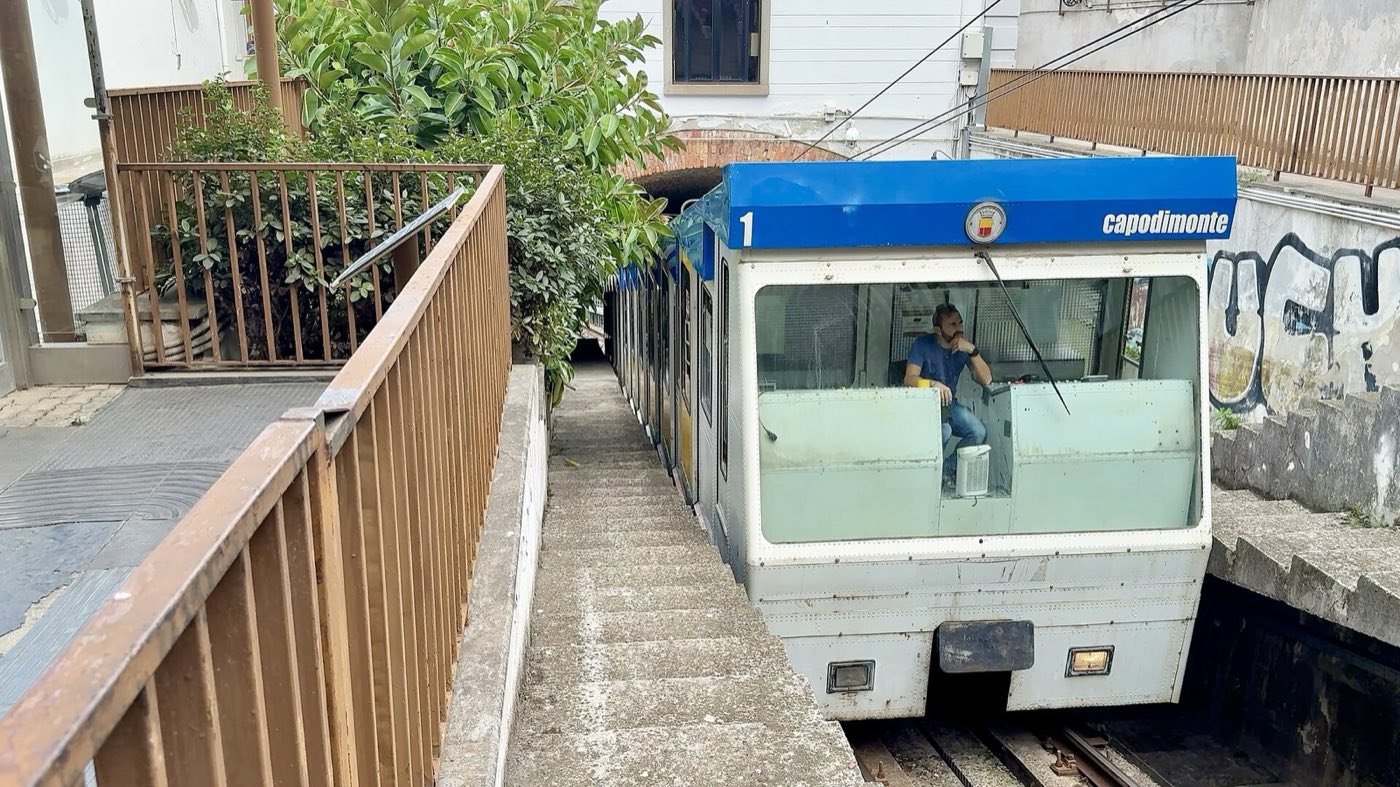
Naples is a vertical city, and its four funicular railways — Centrale, Chiaia, Montesanto and Mergellina — are the century-old answer. The Funicolare Centrale, one of the busiest funicular lines anywhere, runs from Via Toledo up to Vomero in a few minutes; Montesanto serves Castel Sant'Elmo and the Certosa di San Martino viewpoint; Chiaia connects the elegant lower district with the hilltop; little Mergellina climbs Posillipo. They use the same ANM tickets as the metro, run frequently from early morning until late evening, and turn a sweaty 30-minute stair climb into a three-minute glide. For the best panoramas at the top, see our Naples viewpoints guide.
Buses, trams and the trains out of town
City buses exist and the same tickets cover them, but be honest with your expectations: Naples traffic makes surface timetables aspirational, and for most visitor routes the metro-plus-funicular combination is faster and far more predictable. The exceptions worth knowing are the R2-type routes along Corso Umberto I between the station area and Piazza Municipio, and the buses out to Capodimonte, which no metro line reaches. For day trips, two separate railways leave from the Napoli Centrale complex: the Circumvesuviana to Herculaneum, Pompeii and Sorrento (cheap, frequent, crowded — guard your pockets), and metro Line 2 toward Pozzuoli for the Campi Flegrei. In summer, the tourist-oriented Campania Express runs the Circumvesuviana route with guaranteed seats for a higher fare — check current schedules before counting on it. Boats are the other half of the network: see the ferries guide for everything that floats.
Tickets: singles vs day passes
| Ticket | Rough price | When it wins |
|---|---|---|
| Single (90-min types exist) | ~€1.30–1.50 | One or two rides a day; you're mostly walking |
| Day pass | ~€4.50–5 | Three or more rides — e.g. metro out, funicular up, metro back |
| Weekly pass | ~€15–16 | Stays of 5+ days using transport daily |
| Artecard (3+ days) | varies | Bundles transport with museum entries — the math in our city pass guide |
Prices are indicative ANM-zone fares at the time of writing — confirm current tariffs on the ANM site or at station windows. Buy tickets at tabaccherie, station machines or by app, and validate in the yellow stampers on buses and at gates; inspections are real and fines are not negotiable. If your plan is museums-plus-transport for several days, the Campania Artecard usually beats buying the pieces separately.
Hop-on hop-off: when the tourist bus makes sense
Purists sniff at it, but the 24-hour hop-on hop-off ticket solves a genuine Naples problem: the most scenic stretches — the Lungomare, Posillipo's coast road, the climb toward Capodimonte — are exactly the parts public transport serves worst and feet serve slowest. From the open top deck you get the gulf, Vesuvius and the palazzi in one loop, with commentary, and you can bail out at any stop that tempts you. Best for: your first orientation day, travelers with limited mobility, families whose kids have hit their walking limit. Skip it if your whole plan is the compact old town, where the bus can't follow you into the alleys anyway.
Taxis and the flat-rate system
Naples taxis have a reputation, and the city's answer is the tariffa predeterminata: official fixed prices between defined zones — airport to center, station to the port hotels, and so on — printed on a tariff card that must be displayed in every licensed cab. The routine: take only white licensed taxis from ranks or by app, say the destination, ask "tariffa fissa?" and get a number before the car moves. If the driver won't name one, the meter (or the next taxi) is your friend. Radiotaxi apps and the major ride apps that front licensed cabs both work here. Full airport specifics, including rough figures, are in our airport transfers guide.
The walking reality of Naples
Here is the honest core of this page: in the historic center, walking beats everything. Spaccanapoli, Via dei Tribunali, the Duomo, Napoli Sotterranea and the Sansevero Chapel sit within a dense square kilometer where no vehicle helps. Cobbles are uneven and scooters appear from nowhere — flat shoes, eyes up. The trade-off is altitude: Vomero, Posillipo and Capodimonte are proper climbs, which is exactly what the funiculars and Line 1 exist for. The visitor pattern that works: walk the flat, ride the vertical.
- Morning: walk the old town while it's cool — the alleys are the attraction.
- Midday: metro Line 1 or a funicular for any hill destination; art stations en route.
- Evening: stroll the Lungomare, then a flat-rate taxi home if your feet are done.
Timing is everything
- Rush hours (roughly 7:30–9:30 and 17:30–19:30) pack Line 1 and the Centrale funicular with commuters — sightsee outside those windows.
- Sunday and holiday schedules thin out noticeably; check first/last runs if you're out late.
- Strikes (scioperi) are announced in advance and usually respect guaranteed morning/evening bands — if one falls on your day, plan around those windows.
- Toledo station photos: late morning on weekdays is quietest on the escalators.
How to save on transport in Naples
- Count your rides: three or more in a day and the day pass wins automatically.
- Sightsee by metro: the art stations are a legitimate attraction for the price of a single ticket.
- Bundle with museums: the Artecard combinations in our city pass guide fold transport in with entries to MANN, Capodimonte and more.
- Kids ride cheap or free under operator-specific height/age rules — check ANM's current conditions.
- Skip taxis for sub-2-km hops in the flat center; you'll often walk it faster through the alleys than a car can drive it.
FAQ: getting around Naples
How much is a metro ticket in Naples?
A single urban ticket costs around €1.30–1.50 and a day pass roughly €4.50–5, according to ANM tariffs at the time of writing — check the ANM website or the TIC information points for current prices. Tickets cover metro, buses and funiculars within the city zone.
Is the Naples metro safe for tourists?
Yes, by big-city standards. Line 1 is modern, well-lit and busy with locals and visitors. Apply the usual rules: keep phones and wallets zipped away in crowds, especially on Line 2 and the Circumvesuviana, which see more pickpocketing.
What is the Toledo metro station famous for?
Toledo, on Line 1, is famous for its blue mosaic "Crater de Luz" escalator shaft by architect Óscar Tusquets — international media have repeatedly ranked it among the most beautiful metro stations in the world. It's a sight in its own right, reachable with a standard ticket.
How do the Naples funiculars work?
Four funicular railways — Centrale, Chiaia, Montesanto and Mergellina — haul passengers up and down the city's hills, mainly linking the lower city with Vomero. They run frequently from early morning to late evening and accept the same ANM tickets as the metro.
Do taxis in Naples have fixed prices?
Yes, for common tourist routes. Naples licenses fixed flat rates (tariffe predeterminate) between defined points like the airport, the port, the station and hotel zones. Ask for the "tariffa fissa" before departure; the official tariff card must be displayed in the taxi.
Is the hop-on hop-off bus worth it in Naples?
It's worth it if you want the panoramic sweep — the seafront, Posillipo and the hill views — without navigating public transport, or if walking the hills is hard for you. For the compact historic center itself, your feet plus the metro are faster.
Can you walk everywhere in Naples?
The historic center, yes — Spaccanapoli to the seafront is entirely walkable and mostly flat. But Naples is built against hills: Vomero, Posillipo and Capodimonte involve serious climbs. The smart pattern is walking the flat old town and riding metro or funicular for anything uphill.
Getting around Naples clicks once you accept its logic: walk the flat historic center, ride Line 1 and the funiculars for anything vertical, keep a day pass in your pocket and the flat-rate taxi phrase in your mouth. Master that in a morning, and the city's chaos turns out to be mostly choreography.